Dream and waking
Finnegans WakeDream and waking in Finnegans Wake is a porous, repeatedly deferred threshold: sleep quiets the central figure, but voices and imagined disturbances continue around him, and the approach of dawn promises waking without showing it completed. The late-night scenes make consciousness neither wholly private nor securely separate from the world outside; it is watched over, interrupted, and pulled toward the day even as the narrative keeps returning to rest.
Sleep, Sound, and the Unfinished Threshold
The movement toward sleep first appears as a change in the sleeper’s condition: he is quieter now. That small observation gives sleep the force of a settling, but not of a conclusion. Elsewhere he sighs in sleep, a bodily sign that the dream-state remains active even when the sleeper cannot answer. The text registers sleep through signs and reactions rather than by giving a stable account of what the sleeper experiences.
The silence around him is never absolute. Voices remain audible, and the surrounding passage describes them as continuing to be heard even amid the efforts to quiet the scene. Sleep therefore coexists with sound rather than simply replacing wakefulness. It is an inward state approached by listeners who remain alert to what might disturb it.
The imagined disturbance becomes briefly concrete: someone asks whether there has been a stir, then answers that nothing is fast, and attributes the possibility of waking to the wind on the road outside, which might rouse shivering sleepers. The exchange retreats from alarm almost as soon as it raises it. What seems like an event is reduced to weather, while the sleeper’s rest is protected by the others’ attention. The uncertainty itself keeps waking near: an ordinary noise might be a threat, but it might also be only wind.
Vigil and Protection
The scene of hovering dreamwings gives this watchfulness a protective form. A voice imagines those wings folding around a small, vulnerable figure, while asking that a large, strong man be kept safe. The paired images make sleep a condition of dependence: the sleeper cannot guard himself, so protection is imagined as something wrapped around him from outside.
That protection is tender but not wholly calm. The words gather fears together with the wish to guard a child and a beloved figure, joining vulnerability to strength rather than choosing between them. The passage does not explain who speaks or identify every figure with certainty. Its effect comes from the gesture of sheltering, and from the contrast between the still sleeper and the watchful voices that keep fear at bay.
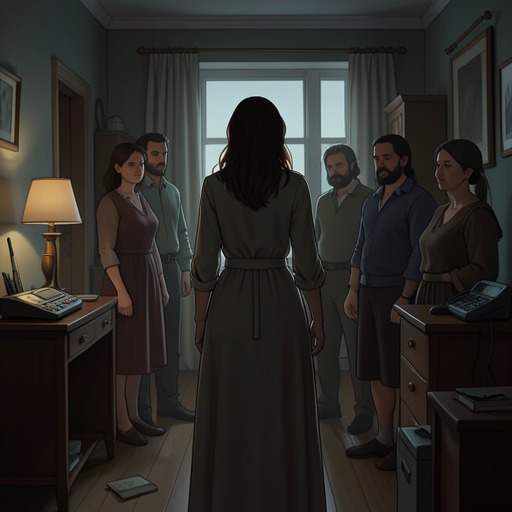
The repeated instructions to go to bed, hide, and avoid waking him turn rest into a shared undertaking. The other figures modify their own behavior around the sleeper; even their speech measures itself against the risk of disturbing him. Dreaming is thus not simply an individual mental state but a social interval, sustained by those who keep watch and by their effort to interpret sounds without letting them become a full alarm.
Rest Beside Public Life
The sleeping figure is set against a densely populated world of speech and activity. A long passage moves through dreamlike pairings, journeys, couples, and places, then abruptly asks whether anyone stirred; the answer returns the scene to the wind and to sleepers on the road. The shift from crowded verbal motion to the explanation of a minor sound makes rest seem precarious, continually bordered by the world’s movement.
The surrounding text also turns toward public voices. A ceremonial passage thanks participants and announces that dawn is nearing; it names Dublin as the place where the droners who doze are to be awakened. Public acknowledgment and communal noise gather around the threshold of morning, but the promised waking remains prospective. The text tells of dawn’s approach, not of a sleeper opening his eyes.
This juxtaposition gives the transition a double scale. Rest belongs to particular bodies, watched over in a room or imagined under sheltering wings, while waking belongs to a larger city whose inhabitants are addressed together. Yet the passage does not resolve the two into a single, clear moment. The public world is already speaking before the sleepers are said to wake.
Dawn, Rest, and Recurrence
The approach of dawn brings the late-night movement to its clearest limit. The text says that the day is nearing in order to wake those who doze in Dublin, while another sleeper rests in peace. These images hold impending waking beside continued sleep: morning advances, but rest is still present at the close of the scene. The shift is not narrated as a completed change from one state to the other.
An announcement of marriage and union follows the dawn language, joining the promise of new bonds to a passage that also insists on separation and renewed division. In this context, waking and sleeping do not simply map onto endings and beginnings. The text repeatedly makes one condition contain its apparent opposite: rest persists as waking approaches, and union is described through the language of bonds and schism together.
The concept’s significance lies in this resistance to a final boundary. The sleeper grows quieter, sighs, and rests; others listen, protect him, and fear that a stir may wake him; the wind offers a mundane explanation; and dawn eventually approaches the sleepers of Dublin. But the sequence stops short of turning that approach into a definite awakening. Dream and waking remain intertwined, with sound, watchfulness, fear, ceremony, and the rhythm of daybreak carrying the reader to the threshold without closing it.